The phrase “Jehovah is our strength” is a deeply significant expression that resonates with those of the Judeo-Christian faith. It highlights the idea that God (referred to as Jehovah in some biblical translations) is the ultimate source of strength, support, and perseverance in life’s challenges.
This phrase is rooted in several passages of the Bible. For example, in Exodus 15:2, after the miraculous parting of the Red Sea, Moses and the Israelites sing, “The Lord is my strength and my song; He has become my salvation.” Similarly, Psalm 28:7 declares, “The Lord is my strength and my shield; my heart trusts in Him, and He helps me.”
The context behind these sentiments often reflects moments of divine intervention or deliverance, where individuals or groups acknowledge their reliance on a higher power to overcome adversity. It serves as a reminder to believers that faith in Jehovah provides spiritual and emotional fortitude.
Faith can be an incredible source of strength during tough times. Here are a few ways it can help:
Providing Hope: Faith often nurtures a sense of hope, reminding individuals that difficult circumstances are temporary and that better days lie ahead.
Offering Perspective: Belief in something greater can put challenges into a broader context, offering reassurance that there’s a purpose or plan even in hardship.
Building Community: Faith often connects individuals to supportive communities, like congregations or groups, where they can find encouragement and understanding.
Instilling Resilience: Trust in God, or a higher power, can inspire perseverance and courage, enabling people to face adversity with greater strength.
Encouraging Reflection: Through prayer, meditation, or worship, faith encourages self-reflection and peace of mind, which can be grounding in chaotic times.
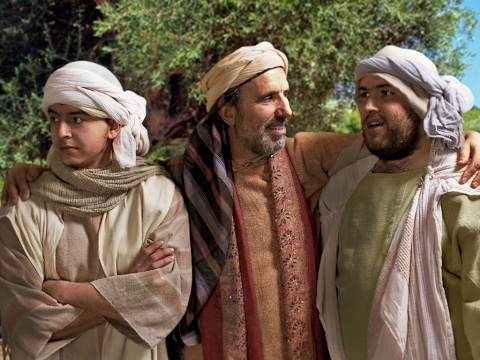
28“What do you think? There was a man who had two sons. He went to the first and said, ‘Son, go and work today in the vineyard.’
29“ ‘I will not,’ he answered, but later he changed his mind and went.
30“Then the father went to the other son and said the same thing. He answered, ‘I will, sir,’ but he did not go.
31“Which of the two did what his father wanted?”“The first,” they answered. Jesus said to them, “Truly I tell you, the tax collectors and the prostitutes are entering the kingdom of God ahead of you.
32For John came to you to show you the way of righteousness, and you did not believe him, but the tax collectors and the prostitutes did. And even after you saw this, you did not repent and believe him.
I can think of six people who had or still have an impact on my Faith the immediate ones obviously being my mother and late father and of course both sets of grandparents.
Apart from my Mother and Father, though I loved my Grandparents very much Faith wise there are two that stuck out and that was my father’s father and my mother’s mother who was a very wise woman.
I think it would be safe to say I got more advise than i did my father’s father as he died before 80 where as my mother’s mother lived passed 100 years old.
1 In the beginning was the Word, and the Word was with God, and the Word was God. 2 He was with God in the beginning. 3 Through him all things were made; without him nothing was made that has been made. 4 In him was life, and that life was the light of all mankind. 5 The light shines in the darkness, and the darkness has not overcome<sup class=”footnote” style=”box-sizing:border-box;font-size:.625em;line-height:22px;position:relative;vertical-align:top;top:0;” data-fn=”#fen-NIVUK-26050a” data-link=”[a]”>[a] it.
6 There was a man sent from God whose name was John. 7 He came as a witness to testify concerning that light, so that through him all might believe. 8 He himself was not the light; he came only as a witness to the light.
9 The true light that gives light to everyone was coming into the world. 10 He was in the world, and though the world was made through him, the world did not recognise him. 11 He came to that which was his own, but his own did not receive him. 12 Yet to all who did receive him, to those who believed in his name, he gave the right to become children of God – 13 children born not of natural descent, nor of human decision or a husband’s will, but born of God.
14 The Word became flesh and made his dwelling among us. We have seen his glory, the glory of the one and only Son, who came from the Father, full of grace and truth.
At an antique desk
An old man sits alone
It’s Christmas Eve
And it’s almost time to go
He signs his name to a letter he just wrote
Then he reads it back with a voice as soft as snow
I want peace on earth for Christmas
In a world where there’s not one hungry child
They would hope and faith
Conquers fear and hate
All I’m asking for is a little more love
Then he walks outside
And he climbs up on his sleigh
And calls out to his reindeer
Off they fly away
Oh tonight he’ll make a million dreams appear
While he wishes that his own dreams would come true this year
I want peace on earth for Christmas
In a world where there’s not one hungry child
They would hope and faith
Conquers fear and hate
All I’m asking for is a little more love
That they would hope and faith
Conquers fear and hate
All I’m asking for is a little more love
lessed assurance, Jesus is mine! O what a foretaste of glory divine! Heir of salvation, purchase of God, Born of his spirit, washed in his blood. This is my story, this is my song, Praising my Savior all the day long.
Tune composer Phoebe Palmer Knapp (1839-1908) played a melody to Fanny Crosby and asked, “What does the melody say to you?” Crosby replied that the tune said, “Blessed assurance, Jesus is mine!” and proceeded to recite the entire first stanza of the now-famous hymn. Knapp was one of several tune writers that worked with Fanny Crosby. It was not unusual for one of her texts to be inspired by a preexisting tune. Knapp was the composer of more than five hundred gospel hymns and tunes.
Fanny Crosby (1820-1915), blind at the age of six weeks, was a lifelong Methodist who began composing hymns at age six. She became a student at the New York Institute of the Blind at age 15 and joined the faculty of the Institute at 22, teaching rhetoric and history. In 1885, Crosby married Alexander Van Alstyne, also a student at the Institute and later a member of the faculty. He was a fine musician and, like Fanny, a lover of literature.
An author of more than 8,000 gospel hymn texts, she drew her inspiration from her own faith. Crosby published hymns under several pen names including “Ella Dale,” “Mrs. Kate Gringley,” and “Miss Viola V. A.” Her hymn texts were staples for the music of the most prominent gospel song writers of her day.
Frances Jane Crosby’s hymns have historically been among the most popular songs sung by Methodists. “Blessed Assurance” (1873) is one of the ten most popular hymns sung by United Methodists according to Carlton Young, and it is one of eight Crosby hymns in The United Methodist Hymnal.
“Blessed Assurance” was published in 1873 in the monthly magazine edited by Joseph Fairchild Knapp and Phoebe Palmer Knapp, Guide to Holiness. Editor John R. Sweney included it in Gems of Praise (Philadelphia, 1873), and Knapp also chose it for “Bible School Songs” (1873). Perhaps the biggest boost came when it appeared in Gospel Songs, No. 5 (1887) by Ira Sankey and was sung extensively in the Moody and Sankey revivals in Great Britain and the United States. It has been a part of Methodist hymnals since 1889.
This hymn has inspired many singers ranging from those in evangelistic crusades to theologians. Don E. Saliers, William R. Cannon Distinguished Professor of Theology and Worship Emeritus at Candler School of Theology, Emory University in Atlanta, borrowed a portion of the opening stanza for his liturgical theology text, Worship as Theology: Foretaste of Glory Divine (1994). If one enters “foretaste of glory divine” into a Google search, numerous sermon titles appear that incorporate this phrase. YouTube renditions of the hymn abound.
Crosby captured the poetic essence of the Wesleyan understanding of Christian perfection in the phrase, “O what a foretaste of glory divine!” The entire hymn is focused on heaven, a place where “perfect submission” and “perfect delight” [stanza 2] will take place. The earthly existence is one of “watching and waiting, looking above” [stanza 3]. As we submit ourselves to Christ and are “filled with his goodness” and “lost in his love” [stanza 3], we are remade in Christ’s image and are moving toward Christian perfection.
This hymn appeals to the senses in a rich way. Not only do we have a “foretaste of glory,” we experience “visions of rapture [that] burst on my sight,” and we hear “echoes of mercy, whispers of love” [stanza 2].
The refrain calls us to “prais[e]. . . my Savior all the day long,” echoing I Thessalonians 5:17, “Pray without ceasing.”
Because of her long life, Fanny Crosby had an extraordinary relationship with several United States presidents, even penning poems in their honor on occasion, and she was influential on the spiritual life of or a friend to Presidents Martin Van Buren (8th), John Tyler (10th), James K. Polk (11th), and Grover Cleveland (22nd and 24th). She addressed a joint session of Congress on the topic of education for the blind.
Middle class women in nineteenth-century United States had little voice in worship, however. One of the only ways for a woman to claim the authority to be heard was by direct personal revelation from God. Fanny Crosby readily claimed God’s personal revelation as a source for her hymns; her personal revelation then became a communal inspiration as Christians throughout the world sang her hymns and confirmed her faith experience as their own.
6 We do, however, speak a message of wisdom among the mature, but not the wisdom of this age or of the rulers of this age, who are coming to nothing.7 No, we declare God’s wisdom, a mystery that has been hidden and that God destined for our glory before time began.8 None of the rulers of this age understood it, for if they had, they would not have crucified the Lord of glory.9 However, as it is written:
“What no eye has seen, what no ear has heard, and what no human mind has conceived”[b]— the things God has prepared for those who love him—
10 these are the things God has revealed to us by his Spirit.
The Spirit searches all things, even the deep things of God.11 For who knows a person’s thoughts except their own spirit within them? In the same way no one knows the thoughts of God except the Spirit of God.12 What we have received is not the spirit of the world, but the Spirit who is from God, so that we may understand what God has freely given us.13 This is what we speak, not in words taught us by human wisdom but in words taught by the Spirit, explaining spiritual realities with Spirit-taught words.[c]14 The person without the Spirit does not accept the things that come from the Spirit of God but considers them foolishness,and cannot understand them because they are discerned only through the Spirit.15 The person with the Spirit makes judgements about all things, but such a person is not subject to merely human judgements,16 for,
“Who has known the mind of the Lord so as to instruct him?”[d]
But we have the mind of Christ.
There’s a peace I’ve come to know
Though my heart and flesh may fail
There’s an anchor for my soul
I can say “It is well”
Jesus has overcome
And the grave is overwhelmed
The victory is won
He is risen from the dead
And I will rise when He calls my name
No more sorrow, no more pain
I will rise on eagles’ wings
Before my God fall on my knees
And rise
I will rise
There’s a day that’s drawing near
When this darkness breaks to light
And the shadows disappear
And my faith shall be my eyes
Jesus has overcome
And the grave is overwhelmed
The victory is won
He is risen from the dead
And I will rise when He calls my name
No more sorrow, no more pain
I will rise on eagles’ wings
Before my God fall on my knees
And rise
I will rise
And I hear the voice of many angels sing,
“Worthy is the Lamb”
And I hear the cry of every longing heart,
“Worthy is the Lamb”
And I will rise when He calls my name
No more sorrow, no more pain
I will rise on eagles’ wings
Before my God fall on my knees
And rise
I will rise
The hymn “Sing the Wondrous Love of Jesus,” also known as “When We All Get to Heaven,” was written by Eliza E. Hewitt in 1898. Hewitt, a Philadelphia native, collaborated with composer Emily D. Wilson to create this uplifting gospel song12.
4 As a prisoner for the Lord, then, I urge you to live a life worthy of the calling you have received. 2 Be completely humble and gentle; be patient, bearing with one another in love. 3 Make every effort to keep the unity of the Spirit through the bond of peace.4 There is one body and one Spirit, just as you were called to one hope when you were called; 5 one Lord, one faith, one baptism; 6 one God and Father of all, who is over all and through all and in all.
7 But to each one of us grace has been given as Christ apportioned it. 8 This is why it[a] says:
‘When he ascended on high, he took many captives and gave gifts to his people.’[b]
9 (What does ‘he ascended’ mean except that he also descended to the lower, earthly regions[c]? 10 He who descended is the very one who ascended higher than all the heavens, in order to fill the whole universe.) 11 So Christ himself gave the apostles, the prophets, the evangelists, the pastors and teachers, 12 to equip his people for works of service, so that the body of Christ may be built up 13 until we all reach unity in the faith and in the knowledge of the Son of God and become mature, attaining to the whole measure of the fullness of Christ.
14 Then we will no longer be infants, tossed back and forth by the waves, and blown here and there by every wind of teaching and by the cunning and craftiness of people in their deceitful scheming. 15 Instead, speaking the truth in love, we will grow to become in every respect the mature body of him who is the head, that is, Christ. 16 From him the whole body, joined and held together by every supporting ligament, grows and builds itself up in love, as each part does its work.
Isaiah 25:1-5New International Version – UK (NIVUK)
Praise to the Lord
25 Lord, you are my God; I will exalt you and praise your name, for in perfect faithfulness you have done wonderful things, things planned long ago. 2 You have made the city a heap of rubble, the fortified town a ruin, the foreigners’ stronghold a city no more; it will never be rebuilt. 3 Therefore strong peoples will honour you; cities of ruthless nations will revere you. 4 You have been a refuge for the poor, a refuge for the needy in their distress, a shelter from the storm and a shade from the heat. For the breath of the ruthless is like a storm driving against a wall 5 and like the heat of the desert. You silence the uproar of foreigners; as heat is reduced by the shadow of a cloud, so the song of the ruthless is stilled.
I’ve had many tears and sorrows, I’ve had questions for tomorrow, There’ve been times I didn’t know right from wrong: But in every situation God gave blessed consolation That my trials come To only make me strong.
Through it all, through it all, I’ve learned to trust in Jesus, I’ve learned to trust in God; Through it all, through it all, I’ve learned to depend upon His Word.
I’ve been to lots of places, And I’ve seen a lot of faces, There’ve been times I felt so all alone; But in my lonely hours, Yes, those precious lonely hours, Jesus let me know that I was His own.
Through it all, through it all, I’ve learned to trust in Jesus, I’ve learned to trust in God; Through it all, through it all, I’ve learned to depend upon His Word.
I thank God for the mountains, And I thank Him for the valleys, I thank Him for the storms He brought me through; For if I’d never had a problem I wouldn’t know That He could solve them, I’d never know what faith In God could do.
Through it all, through it all, I’ve learned to trust in Jesus, I’ve learned to trust in God; Through it all, through it all, I’ve learned to depend upon His Word.
When God says no, He has a plan. Keep trusting Him!